
“We’ve never had this before – they do bad things, then undo some of the bad things, it’s hard to know what’s going on.”
A dear friend and colleague lamented as I power walked through our local park. A 70 degree day in March can’t be wasted and I think better when I’m moving around. There’s something about the fresh air, maybe, that lends perspective. So I use what have become almost daily walks to muddle through dense topics, prioritize, make plans.
“It’s hard to counter anything when you’re on shifting ground,” I added. “Sortof like pirates.”
My friend paused, then laughed. He’s used to my quirky conversations.
Port Royal was a pirate city, located on a peninsula at the mouth of Kingston Harbor in Jamaica. Founded in 1494, by the late 1600s it was the largest and most prosperous city in the Caribbean – owing to the pirates and privateers who appreciated its proximity to Spain’s shipping routes.
Port Royal was the Disneyland of drunken debauchery – the Branson of buccaneers. (If you know, you know.) Widely known as the “wickedest city in the world,” its entire economy hinged on piracy – trading with and catering to the looters. Legend has it that one in every four buildings was a brothel or a bar.
Its location was a double edged sword. It had a large and useful harbor – plenty of ports and easy navigation. But it was built on a glorified sandbar.
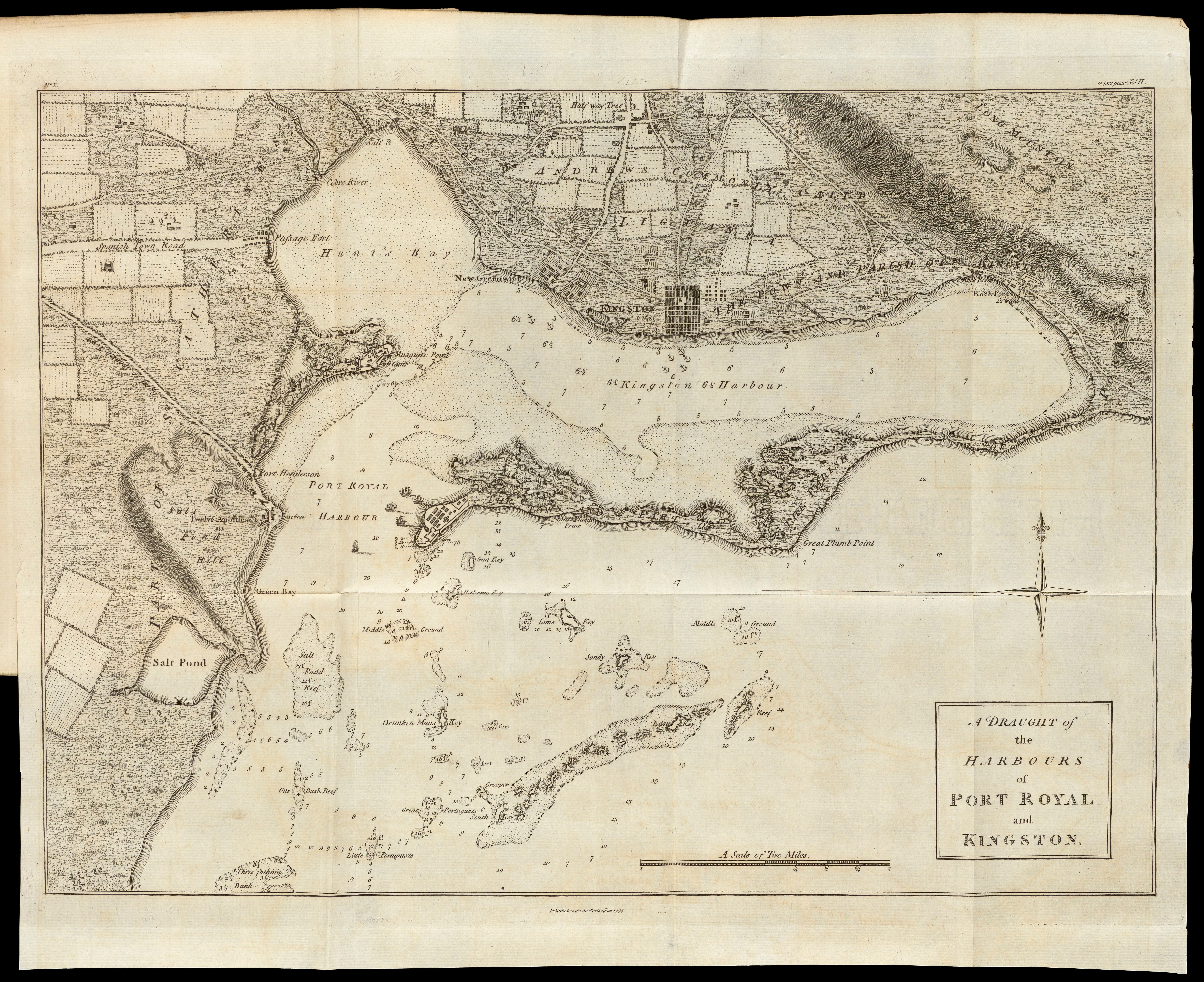
Image Credit: Edward Long.
Port Royal was built on the skinny strip of land that separated the ocean from Kingston Harbor.
With about 6,000 inhabitants and no room to spread out, buildings began to go in the only direction they could. Up.
Brick buildings of multiple stories were common in England, of course, and many of the inhabitants of Port Royal were Brits by birth. Narrow streets and multi-story brick buildings may have made the port city feel just a little more like home. But unlike in England, the buildings in Port Royal were essentially built on a beach – and directly on the ground that was available: sand.
That all worked out just fine for two hundred years.
And then, at 11:43 AM on Sunday June 7, 1692, a 7.5 magnitude earthquake hit Port Royal. (We know the time because of a stopped pocket watch that was discovered during an excavation in the 1960s.)
Witnesses said that as the earthquake hit, the sand undulated in waves, sending multi-story brick buildings toppling into the narrow streets below. That would have been terrifying enough.
But because Port Royal was built upon water-saturated sand, here there was an extra terrifying process to contend with: liquifaction.
Liquifaction occurs when waterlogged sand is shaken such that it begins to act like a fluid. Specifically, it temporarily becomes quicksand. Perhaps you’ve stood at the water’s edge and wiggled your toes in the sand; if you’ve ever noticed that you sank a bit when you did so, you’ve experienced liquifaction firsthand.
This massive earthquake liquified the ground beneath Port Royal. Immediately, ports and people and buildings sank into the quicksand – which (horrifyingly) turned right back to solid ground once the shaking ended.
In a few harrowing minutes in which it looked as though hell itself were swallowing up the Wickedest City of the World, 2,000 people were killed.
The lesson of Port Royal would be, you’d think, to not build on sand or soggy ground.
But we do build on soggy, swampy, water-saturated ground.
We just know that when we build in those places, we need to anchor ourselves deep.
As a baby lawyer, I had a front row seat to watch Trump Tower Chicago being built. I worked in the One IBM building, directly west of the Chicago Sun Times building that Trump purchased and razed to make way for the garish skyscraper that now pollutes Chicago’s skyline.
Now, Chicago’s already built on a swamp – its very existence is an engineering miracle – but the land I’m talking about is right on the Chicago River, and less than a mile from Lake Michigan. I had never considered what it takes to build a high rise in those conditions.
But every day while drinking my morning coffee, I’d look out my office window to see workmen in hard hats far below, going here and there and everywhere. It was fascinating to see all of the different pieces that had to be put in place. And that’s when I learned that in order to build a building as tall as Trump Tower on the edge of a river, you have to sink hundreds of caissons hundreds of feet into the ground – until you reach bedrock (and then a little lower, just to be sure).
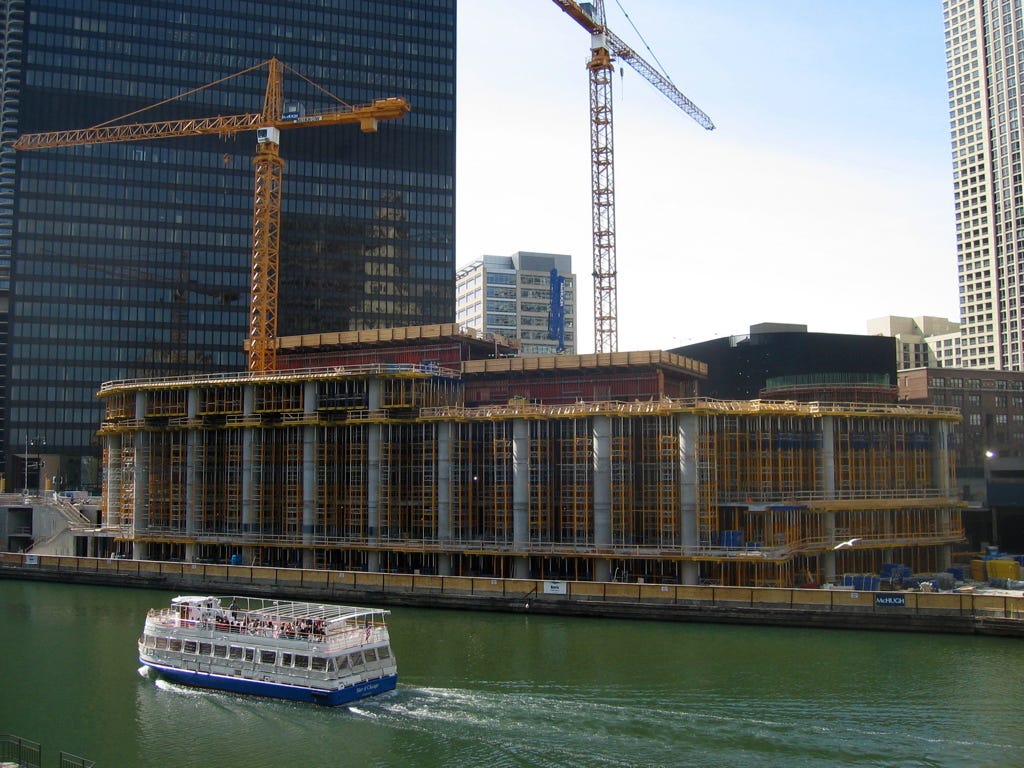
Image Credit: By JeremyA. April 2006 view of the building of Trump Tower, from Michigan Ave. Bridge. I worked in the black building in the background; my office is somewhere in this shot.
That literal bedrock foundation – that sure footing – lends its strength to the rest of the building.
Any structure that is going to withstand stressors from above and below has to have a foundation that is sunk deep into something solid.
That goes for pirate cities, skyscrapers, and movements.
Last week I marveled at the Ukrainians’ spiritual infrastructure. They understand who they are and what they believe and why they are fighting and why it all matters. That gives them the solid foundation to punch well above their weight.
And as I was thinking of moral foundations and infrastructure and sand, my mind went right back to an old hymn we’d sing in church on Sunday mornings – Hymn No. 575. It’s called My Hope Is Built on Nothing Less, but I always remember it from the refrain. “On Christ the solid rock I stand, all other ground is sinking sand.”
So I suppose you could say the message has been drilled into me since I was a little girl singing from the old Lutheran hymnal: When we fight from spiritual solid rock – from a place of values, and faith, and love – we fight from a place of strength.
But that’s part of our current problem. Democrats have built their current structure on two year cycles and polling. Public opinion is our shifting, sinking sand – perfectly solid until something comes along to shake things up and turn once-sure ground to quicksand.
You can feel how we need something more sure-footed now, can’t you? It’s why some legacy Democrats’ public statements about tomato prices or the rising costs of everyday items feel mealy-mouthed. It’s not that they’re wrong. Costs are rising.
It’s that their arguments aren’t coming from bedrock. From a source of strength.
From values.
Meanwhile Bernie Sanders, an 83-year old Democratic Socialist is packing arenas all across the country – especially in red congressional districts. He’s on a barn-burning anti-oligarchy pro-humanity tour.
Friend, he’s not talking about tomato prices.
He’s talking bedrock. Values. Morals. He’s tapping into that spiritual infrastructure that gives people and movements something solid to grab onto. It’s a base of power and strength and courage that feels sure and true.
When I go to Democratic events, I love to ask people what makes them a Democrat. And the answers folks give are always variations on a similar tune: Because I care. Because I won’t leave anyone behind. Because a rising tide lifts all boats. Because many hands make for light work. Because we all do better when we all do better.
There are more, as you know – you could probably recite them in your sleep because they’re what make us who we are. Like the caissons sunk deep into the earth, these value statements hold up everything else – they give our vision, and our party, and our policies, the structure they need.
It’s difficult to steady ourselves in the flurry of unconstitutional and unAmerican actions that are done, then undone, then redone. It’s hard to find sure footing when the earth is shaking under our feet. And lately it’s often felt like once-solid ground has turned to quicksand, and we are sinking into it – alongside structures whose footing we never questioned before.
But if we can’t find certainty in their actions or the structures of the past, we need to find bedrock of our own.
The good news is that it’s available to all of us.
It’s right there, beneath your feet.
We just need to tap into it.
Let’s get to work.
Actions for the Week of March 11, 2025
Friend, things may be heavy – but you can lighten that load by doing something small – a “small deed” – to bring about the world that you want to see.
In doing so we tell the world, the universe, our leaders – and most importantly, ourselves – that we will not go quietly into that good night.
I call it Action Therapy.
That’s why in each Tuesday post I share a few “small things” – usually a Small Thing to Read, a Small Event to Attend, and a Small Call to Make or Action to Take. My intention here is to give you actions you can tuck into your week with ease – and know that you’re doing something today to make tomorrow better.
Join me in doing so. It matters.
Small Call to Make: Call Your Representative to Reject the Continuing Resolution
We’re back in government shutdown territory, and the Republicans (backed by Trump) are hoping to pass another so-called Continuing Resolution to keep the government going through September 30.
Democrats never want a shut down to happen, but voting for this CR would be a terrible idea. Here’s why.
When an appropriations bill is drafted, it lays out where funding actually goes. Report language and detailed funding tables direct where money will be spent. But a full-year CR would omit the “joint explanatory statement,” which is the “report providing congressional direction that accompanies final regular bills.”
Omitting the joint explanatory statement is a big deal. “Not only would this omission ignore thousands of priorities which have already been addressed in the House and Senate Committee bills, but it would leave the administration free to carry out the full-year funding bills without any direction from Congress as to its collective priorities. This is particularly problematic with an administration that already ignores congressional intent.” (Thank you to Rep. DeLauro and the House Appropriations Committee for this helpful explainer.)
In other words, this CR would give Trump/Musk a slush fund.
Republicans can pass this bill without a single Democrat, but they’ll need to move in lockstep. Democrats will need to vote together, too. So this week, please contact your Representative, whether they are a Democrat or Republican. Urge them to vote no on the CR, and explain that it’s because you’re concerned that this is just giving a power hungry billionaire a slush fund of taxpayer money.
When you’re done there, call your Senators. A CR is subject to the filibuster, meaning that 60 votes will be needed. That means Senate Democrats have the ability to block the CR.
Script: Hi, my name is [your name] and I’m at [zip code]. I’m calling because I am concerned that by removing the joint explanatory statement that this continuing resolution will essentially provide a slush fund of taxpayer money. That’s the opposite of fiscal responsibility. I don’t support a government shutdown, but I urge the Congress(wo)man/Senator to vote against this bill.
Find your Congress(wo)man’s or Senators’ telephone number by calling the DC switchboard at 202-224-3121.
Small Event to Attend: Red, Wine & Blue / Tesla Takedown
Red, Wine & Blue: This Thursday at 7pm eastern, Red Wine and Blue will be hosting a talk about the “trad wife” movement. From their event description: “The “trad wife” movement is not just a cultural trend; it is deeply political with strong ties to Christian nationalism. Join us for a conversation with Tia Levings, author of A Well-Trained Wife, as she takes us through the origins of the trad wife movement and the political agenda behind it.”
Tesla Takedown: Yesterday Tesla stock dropped like a SpaceX rocket. That’s a good start, but we need to keep up the pressure. Tesla Takedown events are popping up at Tesla dealerships all over the country. You can find one near you by checking out this link. And because it’s an ongoing series of events, you should bookmark the page (I have!).
Small Thing to Read: The CR Is a Trojan Horse, and USAID’s Impact on World Health
Two great “small things” to read this week.
The first is an excellent piece by Jay Kuo that lays out the issues with the Continuing Resolution. Honestly, it’s the best explainer I’ve read, and I’ve read most of them. It’s worth a read (and if you’re not already subscribing to The Status Kuo, you should!). Here’s a link: The CR Is A Trojan Horse
The second is The Diseases Are Coming, an Atlantic piece written by Craig Spencer, a physician who contracted and recovered from Ebola. He details the impact the funding freezes and the illegal dismantling of USAID has on worldwide public health. Read it here: https://www.theatlantic.com/ideas/archive/2025/03/diseases-doge-trump/681964/
Thanks for reading, friend – I’m glad to see you here! You’re making a difference, I promise.
Small Deeds has always been, and will always be, a free newsletter. But if you like what I do and you want to support it, consider becoming a paid subscriber on Substack.
 Small Deeds Done