Who’s telling our story in Red America?
It’s a puzzling thing that happens in Red State elections.
Progressive policy issues – abortion access, recreational marijuana, Medicaid expansion, paid sick leave – pass with wide margins even as Republicans sweep statewide offices and secure state legislative supermajorities.
What’s going on? How do Democratic policies pass with room to spare in places like Missouri with Republican supermajorities?
The answer may be that some voters believe those Democratic policies … are Republican.
In 2024, the Rural Democracy Initiative polled rural voters in 10 states (AZ, GA, MI, MN, MT, NH, NC, OH, PA, and WI) and found that rural voters often associate popular Democratic policies with Republicans.
When asked who was more focused on progressive policies like tax fairness, protecting Medicare/Social Security, and even supporting abortion rights, nearly 2 in 5 rural voters said it sounded more like the GOP. A block of 40% of rural voters is more than enough to influence election outcomes.
By voting for Republicans, these people are not voting “against their interests” at all. They’re being wholly internally consistent with the information they believe to be true. After all, if you think Republicans are the ones who are going to protect your Social Security and expand Medicaid, you’d not have a problem voting for the Republican. You’d question the sanity of the people who were telling you to vote otherwise. You’d think they were the ones being internally inconsistent.
It begs the question, though: why don’t these folks understand that Democrats’ policy positions align with theirs?
How are they not getting our message?
There are plenty of potential answers. But the most accurate might be the most simple and most obvious. If messages need messengers, who’s sharing the Democratic message in these communities?
Too often, the answer is nobody.
According to Pew Research, U.S. adults most commonly get their local political news from friends, family, and neighbors (70%), local news outlets (66%) and social media (54%). Thirty percent get their local political news from local politicians themselves.
That people get a lot of their local news from friends/family and social media isn’t all that surprising – we see that self-sustaining feedback loop every day. It’s why efforts to influence social media narratives are important, as are the motives of social media companies that have changed policies and algorithms in ways that stifle Democrats.
These “information silos” are real, and have become so impervious that we might need to start calling them bunkers rather than silos. But information has to get fed into them somehow.
And that’s often the job of local news, which gets high marks from both Democrats and Republicans, who generally believe their local news reports the news accurately and covers the most important stories. Basically, folks trust their local stations to be honest brokers about what’s going on in their community.
But are they?
It’s no secret that local news has been declining. A 2024 study by Northwestern University showed that in the last 20 years more than 3,200 newspapers have shuttered. The highest concentration of counties with limited access to local news were in solidly “red” states: Texas, Kentucky, Arkansas, Idaho, Montana and Mississippi.
Trump won 91% of the counties with no local news source – and he won them by an average of 54 percentage points.
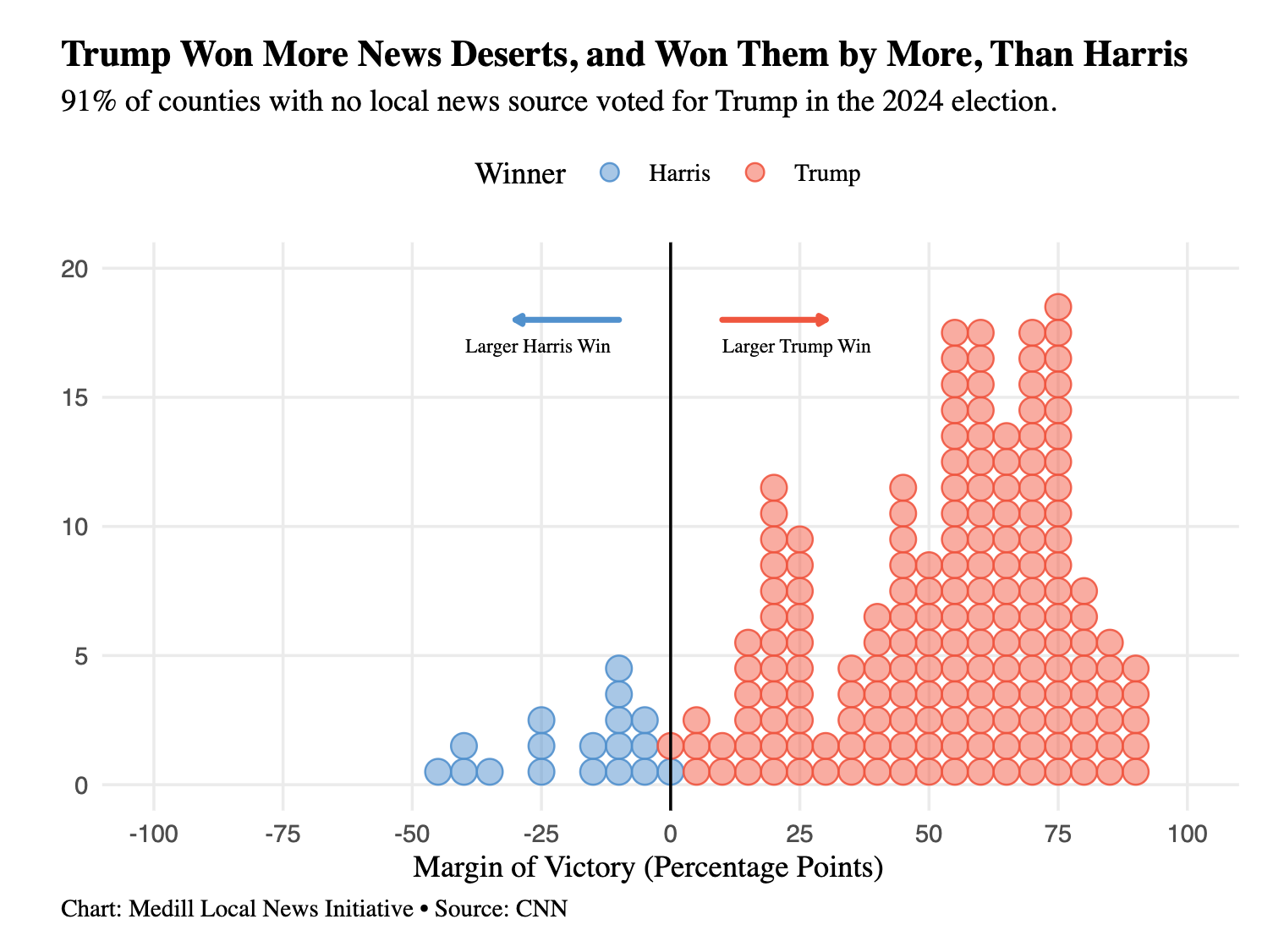
Source: https://localnewsinitiative.northwestern.edu/posts/2024/12/05/trump-wins-news-deserts-in-landslide/
That’s a very interesting correlation. When there’s a lack of local news, “The News” is by necessity national in nature – and in rural America that often means Fox News. Research has already proven the common-sense observation that exposure to Fox News increases Republican vote share in presidential, Senate, House, and gubernatorial elections.
But it’s worth looking at the broader landscape, because Fox is not the only player.
Because often, the local news outlet in the communities adjacent to these news deserts is a Sinclair station.
Sinclair Broadcasting owns, operates, or provides services to 185 stations in 86 markets – about 20% of which are in the swing states of GA, MI, WI, NC and PA. It’s estimated that Sinclair reaches about 40% of American households. These stations retain their local branding as ABC, CBS, or NBC affiliates – and so are viewed by local residents as “their” local news station, regardless of ownership.
Sinclair Broadcasting is owned by David Smith, who doesn’t hide his partisan leanings. During the 2016 campaign he reportedly told Trump that “We are here to deliver your message. Period.”
While located all over the country, at least one former news director claimed that Sinclair “purposely went in and bought a whole bunch of stations in mid-America—i.e., Trump kinds of towns. Places where they could have a big influence. … The bottom line is, they hatched a plan to have an effect on the majority of this country.”
By many accounts, Sinclair has achieved the desired effect.
A 2021 study of Sinclair’s impact on approval ratings for President Obama showed that Sinclair managed to persuade approximately 6% of its audience. A 2024 paper showed that on an individual level, Sinclair increased the likelihood that someone would vote for the Republican candidate in presidential and congressional elections by 8 and 11 percentage points, respectively – and that without Sinclair’s bias Republicans would have lost the 2016 and 2020 elections.
Multiple academic studies of the impact of Sinclair’s purchase of stations reveal the “Sinclair effect” – a significant and measurable rightward shift in content. And at least one study predicted the rightward lurch of the community’s “news diet” to impact election outcomes and promote mass polarization.
Not content to stick solely to the local news game, in 2021 Sinclair established “The National Desk,” which is described as a “commentary-free look” at local and national news. It’s been successful; it now airs on more than 80 stations with morning, evening, late-night and weekend newscasts – which are available for free on all Sinclair news websites, TheNationalDesk.com, and YouTube.
When visiting the site you’re met with their tagline: “Locally covered, nationally connected.” In a cursory view of the site (which I cannot recommend), I couldn’t find any “local” coverage – just Republican talking points. This weekend it published an article citing Fox News as the source for a report that the Kirk shooter lived with a transgender roommate and had “leftist” ideology. The preview highlight reel included a story about the connection between covid shots and children’s deaths, doctors warning about the dangers of e-bikes, and Trump trying to “combat crime” in Memphis.
Earlier this year, Valeria Riccoli joined The National Desk. Riccoli spent 14 years as a Fox News producer, and the last five at the far-right outlet Newsmax.
She is now The National Desk’s Director of Content.
In other words, here we have a partisan, national player wrapping itself in the trappings of a trusted “local” news source and showing up in 40% of American households.
And it’s not just that Sinclair is in 40% of American households. It’s that often it’s the only local option. And like I mentioned above, for news desert communities that lack even a single local outlet, the closest local news is often a Sinclair station.
When you compare the map of Sinclair stations with the map of news deserts, Sinclair’s dominance becomes even more clear.
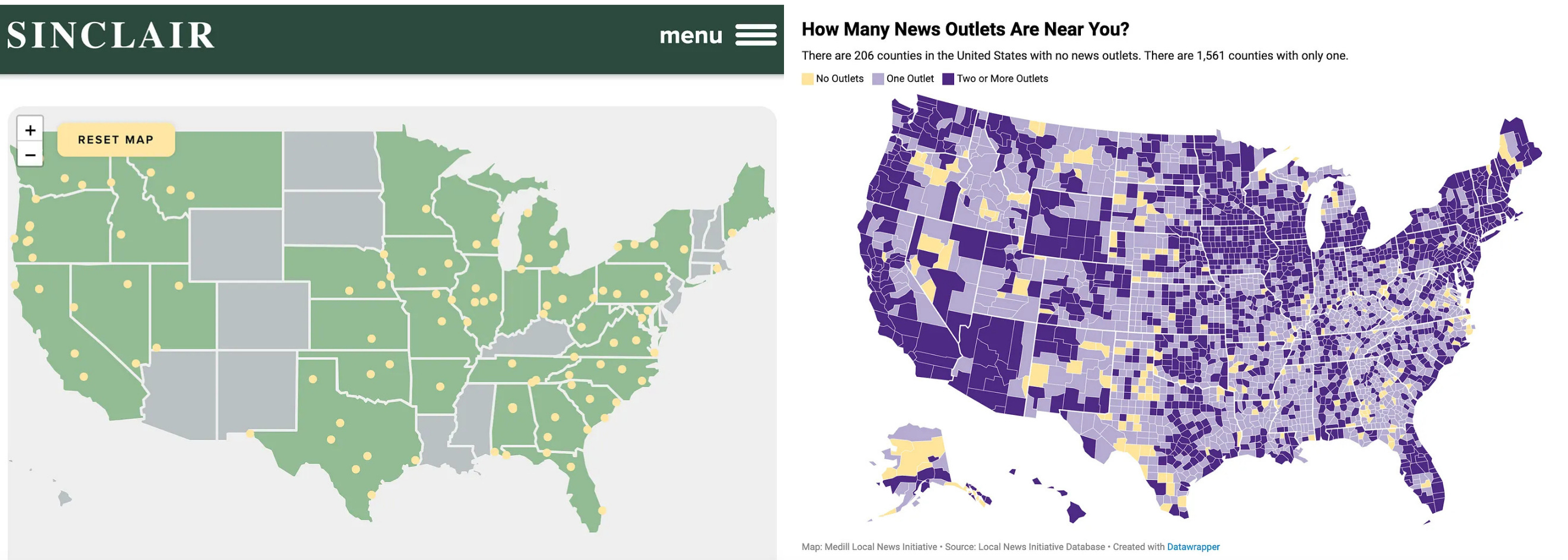
Image credits: https://sbgi.net/tv-stations/, https://localnewsinitiative.northwestern.edu/projects/state-of-local-news/2024/report/
(In the map on the right above, counties that are news deserts with no local option are yellow; those with only one local option are lavender.)
And the only reason Sinclair doesn’t own more stations is because of a federal rule that prohibits ownership of more. A section of Project 2025 advocated for eliminating that federal rule. That chapter was written by Brendan Carr, who now runs the Federal Communications Commission. And, as you’d expect, a new federal rule that would eliminate that last ownership guardrail is currently in the works.
So – what competes with Sinclair in these places? Traditionally that has been public broadcasting. But with the impact of cuts to the Corporation for Public Broadcasting, things are primed to get worse on that front.
It’s hard to imagine that was not by design.
The result is a layering effect of messaging that is incredibly hard to combat. Conservative talking points are introduced nationally through Fox News or programming from the likes of Sinclair’s “The National Desk.” Then at the local level, Sinclair stations operate as “local” news monopolies that repeat must-run national segments under the auspices of highly-trusted ABC/NBC/CBS affiliates. Then local talk radio takes hold, rehashing and discussing “the news” from both local and national outlets that largely parrot the same things. And the local Republican lawmaker’s constituent newsletter adds legitimacy and authority.
And that’s before the social media algorithms bolster all of the above.
This isn’t an echo chamber. It’s an information bunker – where the same conservative messages are reinforced through multiple seemingly independent sources, making them appear more credible and widespread than they actually are.
Confronted with all of these layers of messaging, the million-dollar question is: what on earth can Democrats do about it? It’s not like we can simply spin up local newspapers or t.v. stations that are automatically trusted sources of local news. Those are long-term goals, but we need to get the message out now.
So what can we do in the shorter term? How can we break through?
The answer is both simple and hard.
We show up. In person, and in real life.
If we want to spread a Democratic message, we need an opening. That means we need the messengers to do it – especially in smaller communities. That’s where local political candidates can help, because they can drive, or at least influence, local conversations.
There’s a story of a Democratic nominee in Missouri who went to rallies and campaign events with his water bill tucked into his pocket. (I heard the story from Jess Piper, who had heard it from Missouri activist and AG nominee Elad Gross.) He’d pull out the bill and commiserate with attendees, who understood immediately what he was talking about. His story is one to emulate, because it shows the power in sharing a hyper-local and empathetic message that validates (not contradicts) people’s lived experiences.
That’s what’s available to Democrats when we field candidates in Red America who can translate Democratic values into the local vernacular. That’s true even in – especially in – those races that are considered “unwinnable.”
But far too often, local and state legislative offices are left uncontested – or those races are under-supported. According to Contest Every Race, nearly 100,000 races are left uncontested by Democrats every year. And data that we have at Every State Blue shows just how many races that we do contest in Red America are severely underfunded; it’s a lot.
That isn’t just hurting us electorally (though it’s doing that too).
It’s hurting our ability to break through a very powerful right-wing messaging ecosystem. Every uncontested race is a missed messaging opportunity – a dropped microphone that we can’t afford to pass up.
But we can’t simply ask Democratic candidates to run in these districts and expect them to single-handedly overcome the multi-billion dollar conservative media ecosystem on their own. The structural disadvantage is overwhelming.
Maybe now you can see why I spend so much time working to get real, serious, significant resources to Democrats running in Red America. When we ask people to run in these areas without also supporting them, we’re essentially asking them to fight a propaganda machine with a slingshot. That’s why the solution isn’t just recruitment – it’s investment. Democratic candidates in red districts need funds and campaign infrastructure and help with digital outreach. They need resources to buy local radio time (plenty of farmers listen to local radio in their combines – and it’s one of the least expensive ways to advertise), fund social media campaigns, get gas money to door knock their sprawling districts, and establish a presence in the very communities where Democratic voices have been absent for years.
Folks in these hyper-red districts may or may not win their races. But maybe you can see now why I say that’s not the point. The stakes are so high, and the benefit to having local voices spreading a Democratic message so great, that it’s a no-brainer to give them all the resources they might need. Otherwise, we’re not really solving the messaging problem – we’re just asking individual candidates to be martyrs in an unwinnable fight.
So while Democrats can’t control what “news” is on the Sinclair station, or what’s on Fox, or what’s rehashed on talk radio – we can still get a toe-hold. We can still help push a Democratic message into these communities by running and supporting local candidates.
After all, messages need messengers. Luckily, we already have plenty of potential messengers – all over the country, on the ground, right this very second. They’re organizing their neighbors, informing, educating, and rebuilding infrastructure in traditionally red spaces.
We just need to support them, encourage them, and cheer them on.
Let’s get to work.
Actions for the Week of September 16, 2025
Friend, things may be heavy – but you can lighten that load by doing something small – a “small deed” – to bring about the world that you want to see. In doing so we tell the world, the universe, our leaders – and most importantly, ourselves – that we will not go quietly into that good night.
I call it Action Therapy.
That’s why in each Tuesday post I share a few “small things” – usually a Small Thing to Read, a Small Event to Attend, and a Small Call to Make or Action to Take. My intention here is to give you actions you can tuck into your week with ease – and know that you’re doing something today to make tomorrow better.
Join me in doing so. It matters.
Small Action to Take:
First, in case you were unaware, I’m so passionate about supporting Democrats running in red places that I lead a national organization called Every State Blue that crowdfunds for underfunded Democratic nominees running for state legislature in Missouri, Ohio, and Tennessee – and also supports underfunded Congressional nominees. If you believe we should run and support nominees in every corner of every state across the country, join one of our projects! Just go to https://everystateblue.org and click “projects” in the Menu. Or support our work here.
Is your state not on the list of current projects, but you want one? Please email me at michele@everystateblue . org.
Second, join the No Kings Coalition on September 18 (Thursday) from 8-9pm eastern for a mass call to kick off the work toward the upcoming October 18th national No Kings rallies!
Join to learn more about the vision, urgency, and strategy behind this national day of action. You’ll hear from movement leaders including Ash-Lee Woodard Henderson, Greisa Martínez Rosas, Reverend William Barber II, Randi Weingarten, Keya Chatterjee, Chase Strangio, Ezra Levin, and others about the strategic and moral imperative behind the next No Kings mobilization. Register here: https://www.mobilize.us/nokings/event/839315/?source=Indivisible
Small Event to Attend: So You Want to Run for Office?
Are you thinking about running for office? Then I have a training for you. On Wednesday Every State Blue will host National Democratic Training Committee trainers for a free virtual live training.
NDTC is here to help, so join the meeting to:
- Understand the steps necessary to run for office,
- Learn best practices for choosing which office to run for,
- Identify what support you’ll need from your team, and
- Prepare for sharing your decision to run with friends and family.
This training is right for you if you’re considering a run for elected office but haven’t yet made the commitment to run or filed your candidacy.
Register here: https://us02web.zoom.us/meeting/register/CEPIHvnOT0KtAWoPP5_TiA
Small Things to Read:
Over the last week I’ve learned a lot about the far-right fringe.
One piece that I found to be exceptionally enlightening was about “kitsch” culture: Lost in the Kingdom of Kitsch. The author, Cy Canterel, is a great follow: Abstract Machines with Cy Canterel
Also, if you’ve not yet read it, please do check out this New York Times piece: Trump Is Shutting Down the War On Cancer.
It is an important deep dive on the defunding of cancer research – a dangerous issue that will touch all of our lives. Please share with your people so they can better understand the stakes of this moment.
Thanks for reading, friend – I’m glad to see you here! You’re making a difference, I promise.
Small Deeds has always been, and will always be, a free newsletter. But if you like what I do and you want to support it, consider becoming a paid subscriber.
 Small Deeds Done