
When he was leaving office, Ronald Reagan was asked whether he learned anything as an actor that was useful to him as president.
“I’m tempted to say something,” he said – pausing a little thoughtfully – then continuing. “I’m going to say it. There have been times in this office when I’ve wondered how you can do the job if you hadn’t been an actor.”
I think Trump would agree.
Donald Trump may be described as a real estate executive, a businessman, a politician. But really he’s a showman, plain and simple. He may not be an actor in the style of Ronald Reagan, but as a reality TV star he understands the power of a sticky narrative and a flashy set. He knows how to capture and keep attention. He’s a marketer’s marketer; a huckster and a salesman with a gift for the spectacle.
He speaks in hooks, surrounds himself with bling, and leaves a cliff hanger at the end of every episode.
Unfortunately, America is on the cliff.
Trump and his people have clearly studied Reagan, and they don’t hide it – even his MAGA motto is a ripoff of Reagan’s. There are other similarities. Reagan was criticized for spending one of every six days on vacation, for being thin on substance and thick on flair, and for leaning heavily on ultra-conservative think tanks for his policies. (His administration was the first to use Heritage Foundation’s Project 1981 as its blueprint and mandate.)
Does any of that sound familiar?
Reporters were intensely frustrated with having to cover Reagan because his team was incredibly adept at creating visuals to fit whatever message they were trying to sell that day. Often the cheerful images the team would front would totally conflict with the message reporters were trying to get across to their audience.
So while reporters described hard-hitting facts and sticky issues straight to the camera, the visuals behind them were of cheerful balloons and smiling faces.
It made the administration much more difficult to cover; it seemed like people didn’t listen to the facts.
Because they were too busy watching the show.
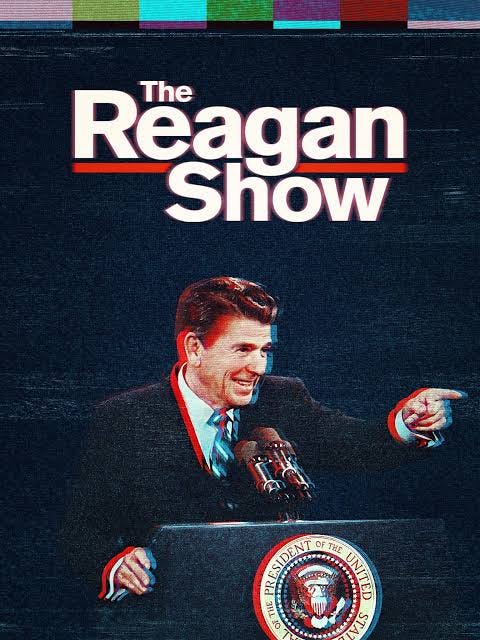
Image credit: The Reagan Show
And the show was closely curated and staged to fit the image of Ronald Reagan as a kind (if tough) cowboy. The golly-gee-aw-shucks neighbor who believed in supporting the little guy, and in American prosperity, and in promoting democracy. Plus, he could ride a horse and use a chainsaw, and deliver a great one-liner with an impish smirk.
When he was asked which was harder – being an actor or being president – he said being president.
Because, he said, “[y]ou not only have to get the part. You have to write the script.”
He and his team wrote a script that presented America as a shining city on the hill – a place where good triumphs over evil, where democracy bests communism, where hard work is rewarded, and where we value prosperity and integrity and sticking up for the little guy. That his policies didn’t match up exactly with the script didn’t matter so much.
“It’s how you stage the message. It’s a game, Barbara,” his Chief of Staff, Michael Deaver, said to Barbara Walters.
I think about that quite a lot now, as we watch a team play the same game – but write a script for a completely different show.
Reagan’s team wrote a script about optimism and potential and American prosperity. The Trump show is about darkness and cruelty and raw power and opulence. And revenge.Subscribed
Over the weekend an event was held to commemorate the death of Charlie Kirk. It was part memorial, part political rally, part revival. All spectacle.
An entire stadium was packed with people who were there to be in community – to mark Kirk’s passing, yes, but also to see the show.
They weren’t disappointed.
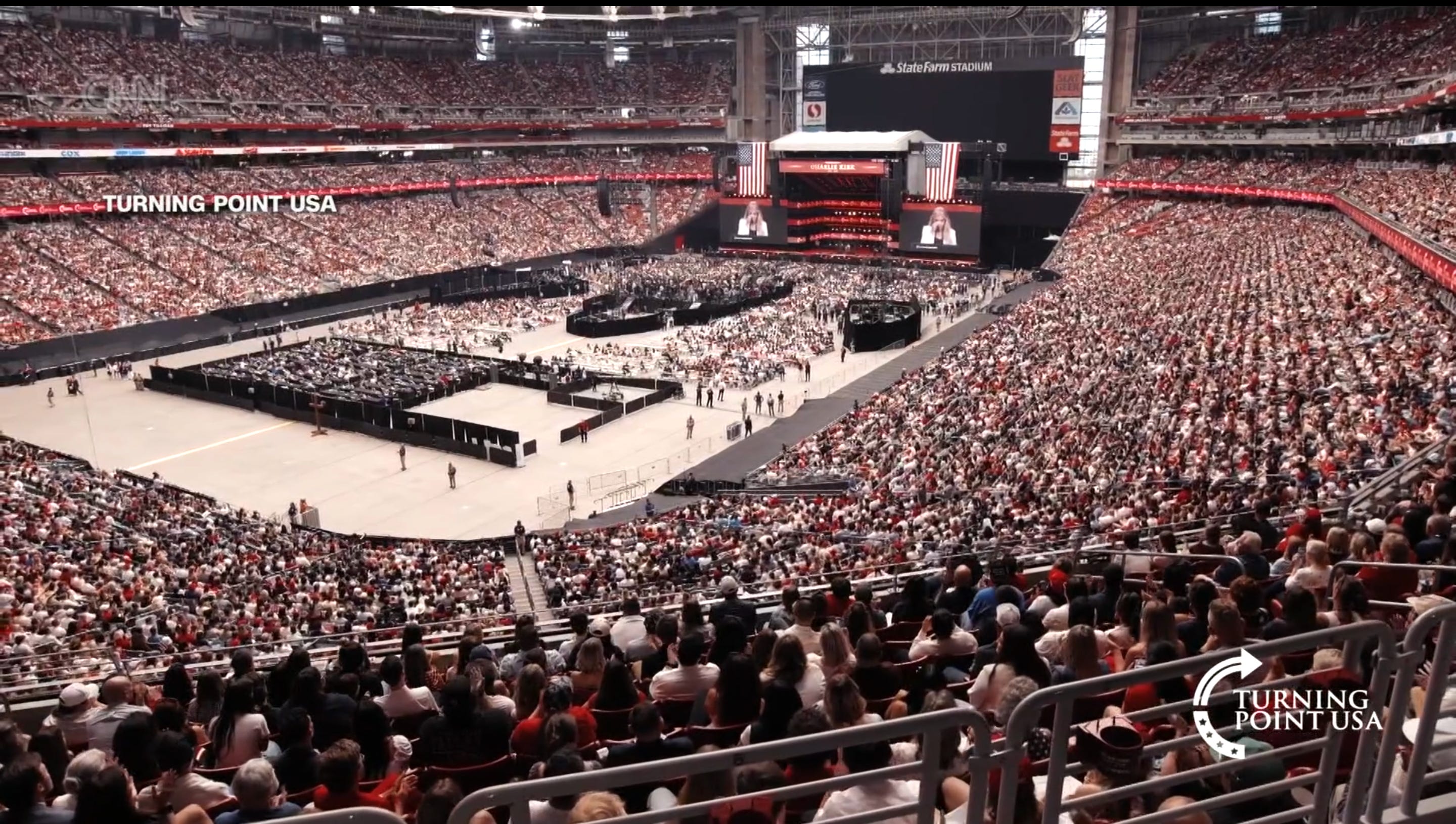
Image credit: screen grab from YouTube event coverage; Fox 5 New York
Nobody should question anybody’s grief or how they present themselves after a loved one passes. But having pyrotechnics go off as a widow makes her entrance at a memorial service seems an intentional choice. Street vendors outside the venue sold merch. Attendees were encouraged to take photos of QR codes that would send them to Turning Point, where they could buy commemorative items.
Everything about the staging of the event suggested it was less a memorial and more a gathering of the Trump faithful.
Trump emphasized that very point in his own words.
In his remarks, Trump said “I hate my opponent,” apparently referring to the tens of millions of Americans who did not vote for him. “And I do not want the best for them.”
Then, to the tens of thousands of people packed into the stadium, and to the millions more watching, he explained: “That bullet was aimed at every one of us. Indeed, Charlie was killed for expressing the very ideas that virtually everyone in this arena and most other places throughout our country deeply believed in.”
So there you have it, friend. At this gigantic show, with attendees high on emotion and group cohesion, he reinforced their key narrative. Good vs. evil – an age-old structure that Reagan used to great effect during the Cold War when the enemy was the USSR and we were the white knights. The problem is that, under this telling, everyone who supports Trump is “good.” The rest of us are “evil.”
And the show continues.
We learned over the weekend, too, that the White House – the people’s house – will be used as a site for an Ultimate Fighting Championship (UFC) match next summer. Organizers plan to “take over” Washington DC, and build music stages and a fighting octagon and seating for up to 85,000. All on the people’s lawn.
Our lawn.
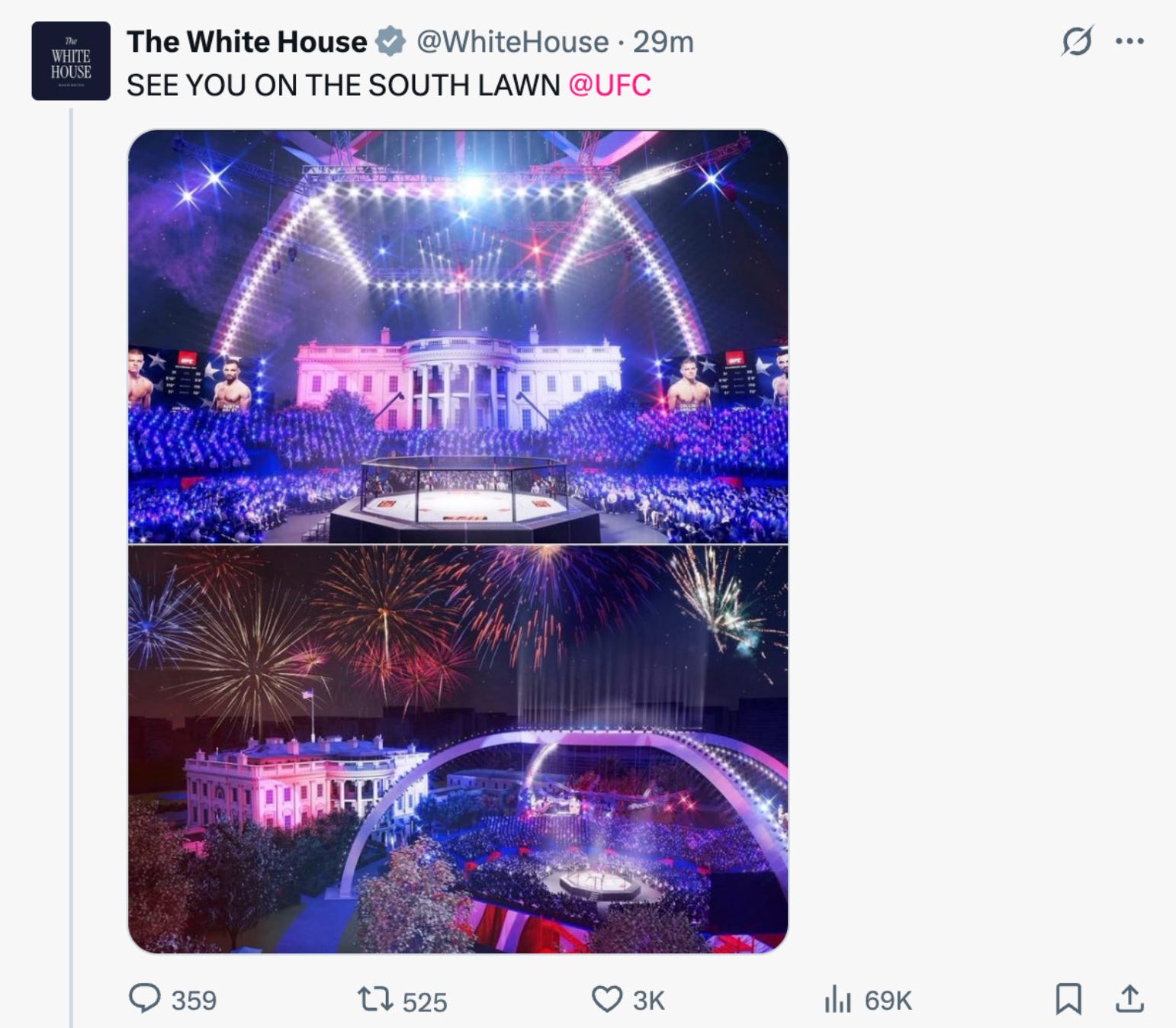
Apparently the vision for the event is to show the White House in the back of the shot; “And then … when the fight goes around to the other side, you’ll see the Washington Monument in the background.’’”
The people’s house and national monuments as backdrop, a background for violence and performative cruelty. The background set to display hyper-masculine power and rage.
People will cheer as the octagon cage, white in the rendering, is splashed with the blood of fighters in live, brutal, hand-to-hand combat.
Violence will be commodified and glorified and promoted on the people’s lawn, in front of the people’s house.
It’s all part of the show.
But, as disgusting as all of this is – there’s something else I want you to consider, and remember, as the show goes on.
Because both Reagan and Trump understood something we sometimes forget. Friend, we’re not just the audience for this show. We’re not even just bit players reading the lines someone else wrote.
We’re the ones who built these stages. We’re the ones who paid for these sets. And we’re the ones who get to decide whether the show goes on at all.
The script they’re writing wants us to believe we’re powerless – that we’re either cheering fans or cowering enemies, trapped in the bleachers while they perform for us. But that’s a lie that’s designed to keep us in our seats.
It’s a lie designed to keep us watching, not doing.
But we don’t have to sit there and watch our sacred spaces turned into arenas. We don’t have to accept performative cruelty – whether that’s in cage matches in front of the White House or in ICE raids on the streets of Chicago. We don’t have to accept that the people’s house becomes a backdrop for blood sport, or that our monuments become props in someone else’s revenge fantasy.
We can walk out. We can demand our money back. We can refuse to buy tickets to a show that turns cruelty into entertainment and democracy into spectacle.
More than that – we can write ourselves back into the story as the people we actually are. Not as extras in their production, but as the neighbors who show up when the cameras stop rolling. As the citizens who remember that governing isn’t performing. As the Americans who insist that our values – actual kindness, actual courage, actual care for each other – aren’t just lines in someone else’s script.
During Reagan’s presidency, Ted Koppel asked “When we finally reach that shining city on a hill, will it be real or just a vacant Hollywood set?”. It’s a good question, but the answer isn’t up to the showmen.
The answer is up to us.
The shining city was always real. It still is. We built it. We live in it. We keep it going with our daily decision to carry on, with our stubborn hope, with our refusal to let anyone else write our ending.
The showmen? They come and go. The cameras eventually stop rolling.
But we the People remain.
And the ending – the real ending, not the one they’re trying to sell us – is still ours to write.
Let’s get to work.
Actions for the Week of September 23, 2025
Friend, things may be heavy – but you can lighten that load by doing something small – a “small deed” – to bring about the world that you want to see. In doing so we tell the world, the universe, our leaders – and most importantly, ourselves – that we will not go quietly into that good night.
I call it Action Therapy.
That’s why in each Tuesday post I share a few “small things” – usually a Small Thing to Read, a Small Event to Attend, and a Small Call to Make or Action to Take. My intention here is to give you actions you can tuck into your week with ease – and know that you’re doing something today to make tomorrow better.
Join me in doing so. It matters.
Small Action to Take: Speaking of Shows…
As you well know, Jimmy Kimmel Live was cancelled last week, after Sinclair and Nexstar affiliates said they would not run the show in the designated spot, and Disney/ABC followed up by terminating Kimmel outright.
The reaction from us was swift and fierce! In response, Disney/ABC relented, and Kimmel returns to the airwaves tonight, September 23. Except that Sinclair and Nexstar have already said they will not be running the show. (For more on the importance of these conservative affiliate owners, you can re-read last week’s column, which was unfortunately timely. Here’s that link.)
Some amazing folks have put together a toolkit that we can all use to make our voices and collective power felt. It is a living document and is being updated regularly, so you can go here for up-to-date information and suggestions on how to push back. You can leave a comment for Sinclair or Nexstar, contact their national or local advertisers, or simply boycott the stations. There are lots of options – I challenge you to pick one and do it today! Here’s the link.
Small Event to Attend: Why Fascists Fear Teachers – A Conversation w/ Randi Weingarten
From the event description: Across history, authoritarian regimes have feared educators—because teaching truth and critical thinking empowers students and communities to resist oppression. Today, public education is under attack, and defending teachers is defending democracy itself. We have seen broad attacks and lies against subjects like Critical Race Theory and the accurate retelling of our nation’s history of oppressing black and minority demographics. We have also seen attacks against reputable educators and accurate content – from the deepest of red and rural America to the bluest of urban centers. All of this is an attack against the truth and fact.
Join Randi Weingarten, President of the American Federation of Teachers, for a dynamic conversation on her book, Why Fascists Fear Teachers. Randi will highlight how educators fight for freedom in classrooms, the dangers of censorship and attacks on schools, and why standing with teachers is a revolutionary act.
This sounds fantastic! Register here
Small Thing to Watch: The Reagan Show
While I typically share a small thing to read, this time I wanted to share something to watch!
I was up way, way too late last night watching The Reagan Show – an excellent documentary that’s pieced together from archival footage. Honestly, I was riveted and I found it to be such helpful history to understand the present moment. You can watch it on Tubi or on Kanopy if you have a library card. (Also, you need a library card if you don’t have one!) It’s only 1.5 hours but worth every second.
Thanks for reading, friend – I’m glad to see you here! You’re making a difference, I promise.
Small Deeds has always been, and will always be, a free newsletter. But if you like what I do and you want to support it, consider becoming a paid subscriber.
 Small Deeds Done