
I typically write essays, not explainers. But I’m making an exception today because I think it’s so critical that you understand the stakes. I’m not hearing many folks talk about it – maybe because it’s wonky, and takes longer than a sound bite to explain.
But friend, Republicans are masters at making existential fights look like boring policy spats so that folks will scroll on, or get confused, or miss the bigger picture. This is no exception.
I worried in writing this that it would be too weedy, or too cerebral, to resonate with people. But the stakes are too high for me not to lay out the implications of what is unfolding for you.
Today, Tuesday September 30, we’re hours away from a government shutdown because Republicans refuse to permanently extend the subsidies that make insurance affordable and accessible to most of the people who get their insurance through the Affordable Care Act market.
But this fight is bigger than subsidies. It’s about the very future of the Affordable Care Act market.
Here’s why.
It’s because of something called a death spiral.
I heard about death spirals for the first time as a young lawyer in the small Chicago office of a large international law firm. We did a lot of reinsurance work, and I cut my litigator teeth on these fights between hulking insurance giants. In general terms, reinsurance is insurance for insurance companies, so I suppose I have more than a basic understanding of insurance pools and risk.
You already know that insurance companies price their products according to risk. The larger and more diversified the pool of people being insured, the lower the risk – and therefore the lower the cost for everyone.
Statistically speaking, young people who don’t have preexisting conditions will be less likely to use benefits, whereas older people who have a history of health issues have a tendency to use more of those benefits. Ergo, younger healthier people cost less to the system. (Those are generalities, of course.)
But to balance out the risk pool, you need the participation of both groups – those who use fewer benefits will balance out those who use more.
Problems arise when younger and healthier people leave the risk pool – say, because the health insurance premiums have risen exponentially and they don’t believe the risk to them personally is worth the cost anymore.
The people who remain in the pool – even though costs have increased – are more likely to use healthcare benefits, and therefore cost more to serve. To account for those additional expected costs (and to remain profitable), the insurance company has to raise premiums again.
When they raise those premiums, more people who are less likely to use healthcare benefits leave the risk pool – leaving behind those who are more expensive to cover. The insurance company raises rates again to cover the additional expected costs.
This goes on, and on, and on – in a self-imposed spiral until the premiums are unsustainable and the whole thing implodes on itself.
That is what is called an “adverse selection death spiral.”
The more balanced and diverse the risk pool, the lower the costs are for everyone, and the more stable the market. The less balanced the risk pool, the higher the costs are for everyone, and the less stable the market. This is why Democrats have worked so hard to increase the number of people in the ACA market – through enhanced subsidies that make it more affordable and attractive for younger and healthier people, and through easier and extended enrollment.
I have a hunch this is also why Republicans have worked so hard on the opposite.
So there are two intersecting things going on right now, and both deal with costs. One is a premium increase, and the second is the expiration of expanded subsidies that make ACA coverage affordable for people.
These two issues – premium increases and subsidy expiration – aren’t just happening at the same time by coincidence. They’re feeding into each other in exactly the way that creates a death spiral. The expiration of subsidies will push younger and healthier people out of the market, which is driving insurance companies to raise premiums now, which will push even more people out. It’s a self-fulfilling cycle.
But let’s talk about the expiration of the enhanced subsidies first, because they set this whole cycle in motion.
Ninety-three percent of marketplace enrollees receive premium tax credits of some kind. In the last few years, Democrats were able to pass enhanced subsidies that made coverage more affordable for more people. But unless Republicans relent, those enhancements will end in December 2025.
The results will be catastrophic for many people.
Take this example from KFF, a well-respected health insurance publication.
A 55-year-old couple making $85k will lose their ACA subsidies and go from premiums of $7,225 to $24,535. Their monthly bill will more than triple– going from a $602/month premium payment to a $2,044/month payment. Take home pay for someone making $85k is a little over $5k/month, so these premiums would be nearly half their income.
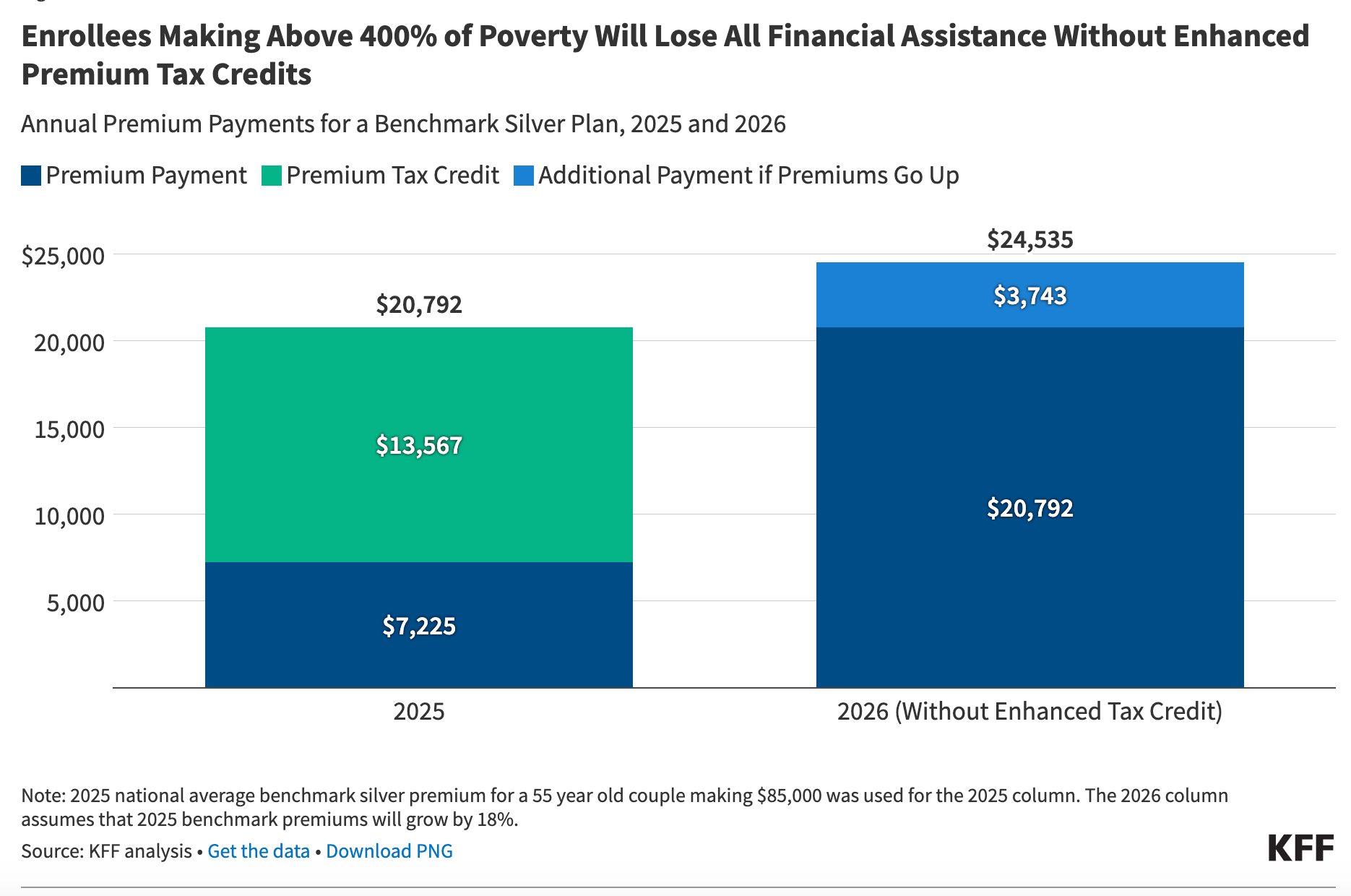
Image credit: KFF
Or these examples from the Center on Budget and Policy Priorities:
A 60-year old couple that makes $82k a year will lose their ACA subsidies and go from premiums of $6,970 to $25,331. Monthly, they’ll go from $580/month to $2,110/month.
A family of four that makes $126k will lose their ACA subsidies and go from premiums of $10,710 to $19,068. Monthly, they’ll go from $892/month to $1,589/month.
(You can see more examples at CBPP here.)
Mind you, these are just premium costs and don’t account for deductibles or copays.
These eye-popping increases will force people to make heartbreaking choices.
And insurance companies know that.
Thus, the second issue we are facing: premium increases.
Every year, insurance companies have to submit their rate increases for ACA market plans to state authorities for sign off. They do this every year in the spring and summer, and those increases are evaluated and approved in the fall before the open enrollment period begins November 1.
This year, insurance companies have requested a rate increase of an average of 18% – which is the highest increase since 2018, the last time Republicans held all levers of government and the insurance industry was similarly concerned about instability in the market.
The companies give a few reasons for the increases, including higher healthcare costs (a perennial issue) and the impact of tariffs. But they also cite their expectation that there will be lower enrollment of younger and healthier people due to the expiration of the subsidies. With rate filing and rate setting season already essentially over, premium increases are, at this point, baked in.
So not only have the Republicans endangered the stability of the market, they’ve also increased costs for everyone in the ACA market already.
Again – regardless of whether Democrats are able to get Republicans to permanently extend the subsidies – people will still face higher premiums that were directly caused by this gamesmanship.
That’s why this fight isn’t just about “subsidies.” It’s not even about healthcare costs for specific slices of the market.
It’s about the stability of the whole ACA system.
Republicans would probably say they’re concerned about the ongoing cost of subsidies to taxpayers, or that they’re trying to reduce the deficit. Some might claim the enhanced subsidies were always meant to be temporary pandemic relief, not permanent. Others might say they want to replace the ACA with something better, or that market competition will bring costs down if the government steps back.
I don’t buy any of it. The subsidies cost far less than the chaos that will follow if Republicans let them expire. When millions of people lose coverage and the individual market is thrown into disarray, the costs get shifted back to taxpayers anyway – just in a more expensive, less efficient form. Meanwhile, people – real people – will suffer tremendously. That’s a human cost I’m unwilling to bear. And after fifteen years, Republicans still haven’t come up with a real alternative to the ACA. What they’re offering isn’t a replacement.
It’s just destruction.
Like I said, Republicans are masters at making existential issues sound boring and confusing. (Think gerrymandering and tax breaks).
Don’t let them trick you like that. Democrats are fighting like hell. They should be. And we need to support them like this is the crisis that it is.
So today, please – call your Congress(wo)man and both of your Senators, regardless of party. (More on that in the actions section below.) Tell them you support making these subsidies permanent. Share this with people who need to understand what’s at stake.
And if you’re in the ACA marketplace, start preparing now for what might be coming.
Let’s get to work.
Actions for the Week of September 30, 2025
Friend, things may be heavy – but you can lighten that load by doing something small – a “small deed” – to bring about the world that you want to see. In doing so we tell the world, the universe, our leaders – and most importantly, ourselves – that we will not go quietly into that good night.
I call it Action Therapy.
That’s why in each Tuesday post I share a few “small things” – usually a Small Thing to Read, a Small Event to Attend, and a Small Call to Make or Action to Take. My intention here is to give you actions you can tuck into your week with ease – and know that you’re doing something today to make tomorrow better.
Join me in doing so. It matters.
Small Call to Make: H/T Jess Craven for the great script!
Please call your Congress(wo)man and your two Senators today – they need to hear from all of us that we understand what’s at stake. Make your voice heard on this issue please!
You can dial the D.C. switchboard here: 202-224-3121.
Script: Hi, my name is (your name) and I’m a constituent at (zip code or address, whatever the office requires to log your call). The ACA subsidies need to be made permanent.
I’m calling to say that I fully support Democrats in their demands for a permanent extension of the ACA premium tax credits, a reversal of Republicans’ Medicaid cuts, and strong guardrails to prevent Trump from using rescissions to claw back funds that Congress has already appropriated. I support Democrats in doing anything they have to do, including allowing the government to shut down, in order to win these concessions.
[If Democrat add:] Please tell Democratic leadership to hold strong until we win. We have your backs.
[If Republican add:] I will still blame Republicans if there is a shut down —after all, they control the government, and they’re the ones who have allowed Trump to violate the Constitution over and over again. They should give Democrats everything they’re asking for and start doing their jobs by reining Trump in. Thanks.
Small Thing to Read: ACA Subsidy Coverage by KFF and CBPP
Both KFF and CBPP do a great job of breaking down this issue, so if you’d like to get more into the nitty gritty you can check these out: https://www.cbpp.org/research/health/five-key-changes-to-aca-marketplaces-amid-uncertainty-over-premium-tax-credit
Small Event to Attend: ACLU’s Protest Safety, Know Your Rights and De-Escalation Training on Monday, October 6 at 8 PM ET
On October 18, many of us will be joining in-person protests. To help us prepare, the ACLU is hosting a zoom training/event centered on protest safety.
From the event description:
”This October, communities across the country will mobilize en masse for the second No Kings national day of action- a mass mobilization against President Trump’s abuses of power and federal crackdown on our freedoms. Together, we’ll send a clear message: the people will not be silenced.
To prepare, join the ACLU’s Protest Safety, Know Your Rights and De-Escalation Training on October 6 at 8 PM ET. This training will give you the tools to take action safely, confidently, and with key de-escalation strategies in hand. Whether you’re marching, rallying, or supporting from the sidelines, you’ll learn how to protect yourself, your community, and stand up for your rights.
What we’ll cover:
- Know your rights during protests and law enforcement encounters
- Practical tools for safety and de-escalation in tense moments
- Get prepared to take nonviolent action safely, powerfully and together
- Build the knowledge and strength to support others in the streets and beyond
Because when we know our rights, we can defend them. Let’s get ready. RSVP NOW.”
RSVP through this link: https://act.aclu.org/a/no-kings-kyr-eng1
Thanks for reading, friend – I’m glad to see you here! You’re making a difference, I promise.
Small Deeds has always been, and will always be, a free newsletter. But if you like what I do and you want to support it, consider becoming a paid subscriber.
 Small Deeds Done